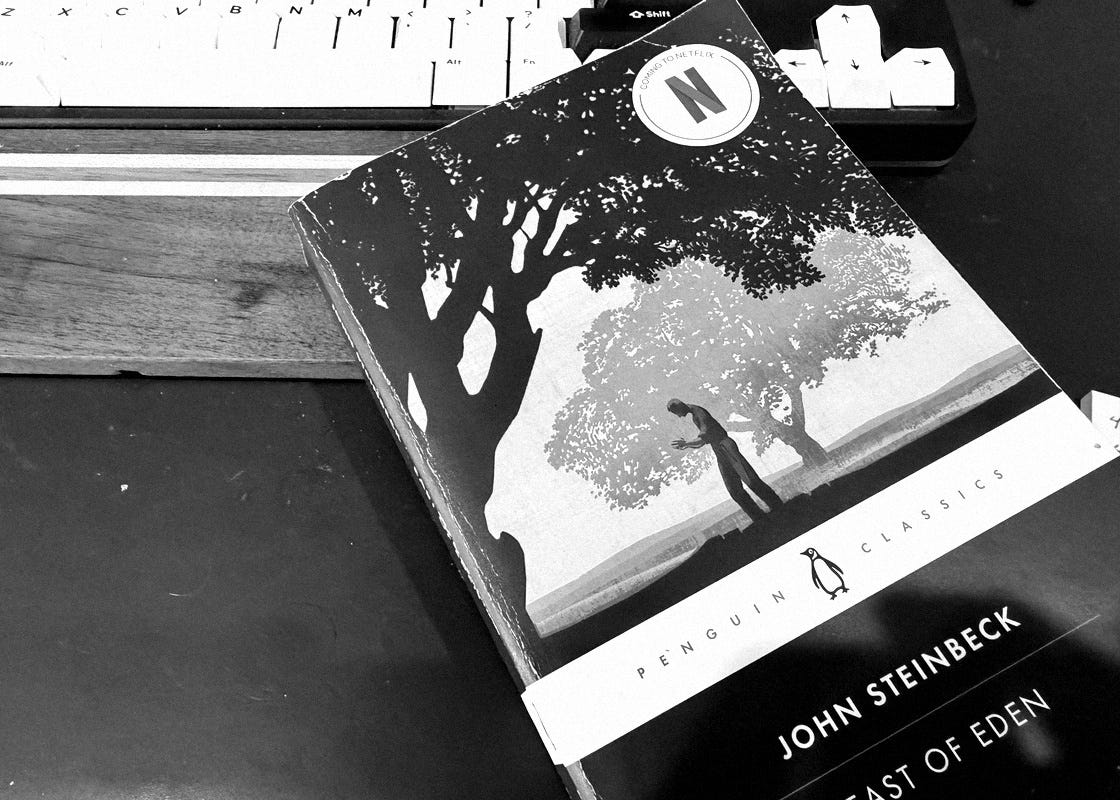
Readers, it’s been a minute. To pull back the curtain, I usually balance a pair of articles, sending one to the shredder while promoting the other, but I didn’t feel either was worthy. It happens; I’ll circle back to them. And it’s not unheard of for pieces and blocks of writing to be reimagined. There’s a quote attributed to Faulkner, “In writing, you have to kill your darlings.” So I had to scrap 5,250 words because they didn’t work. Also, I’ve been traveling and working on a coding project that’s ballooned. Everything takes longer than it should; I’ll be writing a few posts on this project as my text analysis science project is coming to conclusion. Excuses aside, I revisited an old friend from my high-school English class and thought I’d share my notes. Yes, John Steinbeck wrote with style. Away we go.
Oh, the way of this world. What are we rewarding in this economy? Yes, the tech gods are moving fast, throwing caution into gale force winds in a constant push to break, uh, stuff. Begun the AI wars have. Would Master Yoda approve? There are costs to this pace. In the AI race, the pressure to win has turned the written word into an odd raw material.
For those who don’t know how these models work, they feed off training data. And this comes from all of us. Our tweets. Facebook posts. Curated content is considered gold, leading to creators fighting for compensation. And when creators canfight, they fight in court, where the US legal system does its slow grind, a business well known to those with a taste for pain and time. At $475 an hour, the court system can bleed a plaintiff dry.
To catch everyone up, authors Andrea Bartz, Charles Graeber, and Kirk Wallace Johnson (and millions of others rooting for them in spirit) sued the so-called above-board Anthropic for copyright theft. The AI Titan downloaded millions of books from what’s known as shadow libraries, so Claude could talk to us with fond terms like, “It’s fair to push back on this.” It takes an enormous amount of data to make memes and generate text. For the newly initiated, an entire training-data economy has attracted opaque intermediaries, speculative claims, and a certain reputation. Some believe these are fronts and scams to protect larger companies, including Microsoft, OpenAI, Google, and others.
But it isn’t only digital text at risk. Physical copies aren’t spared in this shady ecosystem.
Used-book-store sales are skyrocketing; older titles are being sold en masse. Why? Well, because they’re untouched by AI. A book published in 1985 hasn’t been touched by the machine. And AI self-generated content pollutes the training runs. Studies suggest some new models go into what’s known as a death spiral, regressing as they feed on their own content.
The net is that our AI overlords need creator-derived data to improve. And this makes old books valuable. Which raises the question of what happens once they’re scanned, because scanning and efficiency don’t always go hand in hand. True to form, these ethical companies probably cut the covers off, strip out the spine, and scan each page in bulk. The husks go to the recycler. Sigh. Move fast and break things. Use the wood chipper on glass to cut your feet later.
But in this pivotal case, after many months, Judge William Alsup reached a split decision (the authors didn’t win outright):
Anthropic’s model training was considered fair use based upon the facts involving the named plaintiffs. Sigh.
Digitizing lawfully purchased print books was also fair use. Ugh.
Building a permanent library using pirated work was not excused by fair use. And purchasing lawful copies later did not erase any earlier infringement. A right doesn’t make up for the wrong.
The authors won the battle but lost the war.
A trial to hash out the piracy damages was on the books, but the parties settled instead. And the judge overseeing the proceedings granted final approval where the AI giant paid $1.5 billion plus interest. Sounds like a fortune, but after lawyers’ fees and expenses, the authors received roughly $3,500 per book by some estimates. Depending on contractual obligations, publishers can take half of that, leaving roughly $1,500 to $2,000 per title for the creator. It’s a tough economy.
The settlement resolved a legal claim. But not the larger question: What exactly is a book worth after it helped build a machine valued in the trillions? One story, it turns out, answers that better than any payoff or accounting write-off can.
A Keepsake Chest
Books are more than pages and plot. They contain years of learning, doubts, erased sentences, unused drafts, and the risk of putting oneself out there. Multiple John Steinbeck titles are flagged in the case database. Of Mice and Men. Cannery Row. And, of course, East of Eden. He wrestled with his masterpiece for decades, though the most intensive writing occurred over a three-year period.
And, if you’re curious, he wrote the entire story in longhand. Each morning. Let’s say two thousand words, right after his coffee. The foreword in my version mentioned he drafted a letter to his editor daily to get the creative juices going. Hey, we all have our habits. When finished, he presented his 250,000-word draft to his editor in a hand-crafted keepsake chest. “Well, here’s your box. Nearly everything I have is in it, and it is not full. Pain and excitement are in it, and feeling good or bad and evil thoughts and good thoughts—the pleasures of design and some despair and the indescribable joy of creation. And on top of these are all the gratitude and love I have for you. And still the box is not full.”
I read this decades ago, but found it calling to me on a dusty Barnes and Noble shelf. It was like catching up with an old friend. But this isn’t just any friend.
East of Eden is one of literature’s titans; many top book lists highlight Steinbeck’s masterpiece as the book of our time. Yet, reading this beast took me nearly forever. Not because Steinbeck isn’t great—he’s a legend. But, at times, I found the rhythm hard to grasp, even compared to his other efforts like Cannery Row. His prose. The style. The way the narration unfolds. These characters are compelling. However, the point of view sprints in and out of the characters’ heads. One paragraph, I’m seeing how Cal thinks; a sentence later we drop into Abra’s mind.
Nobody writes like this anymore.
Modern prose abandoned this in favor of Gone Girl unreliable narrators. Yes, some argue nobody ever wrote like this. How we talk is centered in a writer’s style. It’s about voice. Finding Steinbeck’s structure, or discovering it again, took days. A hundred pages in, it clicked. This was his life’s argument, the one he’d been having with himself long before he picked up pen or pencil. Sure, there is a narrator telling the valley’s story. But I’d say that’s him playing a role: a fictional version of himself, an outside observer staring down at a family tree like a genealogist contemplating past lives. Imagine yourself at Christmas dinner talking about a family branch—Great Uncle Jeff, twice removed, shunned over a land dispute, who left the county forever and married a prison outcast. So when he goes into Cal’s or Kate’s head, the narrator is projecting how he thinks they think. It’s intentional, because it backs up the storyteller’s claim that he knows the family from the inside out.
And that’s genius.
This authority matters in how the author casts moral judgment, especially with Kate. She’s written as the complex villain who dug up dirt on her clients, killed her boss, and shot her husband in the shoulder, though he loved her more than life itself. Literary types have argued the evildoer deserves sympathy because she’s trying to escape a world that wants to cage her. But that’s not what’s written. The narrator believes she’s evil. He all but says love doesn’t exist inside her; there is no getting past this point of view.
Heady, I know. Steinbeck built a different type of unreliable narrator. Once I found the perspective, the book takes off. The characters are epic. Why wouldn’t it soar?
But what makes it transcendent is that Steinbeck took a risk. He built on his craft, using his flair for dialogue from Of Mice and Men and Cannery Row. And then he wove together a complex story spanning families over decades. This book conveys a message. It’s not just telling a story.
The Unrepentant Chapter 34
And Steinbeck refused to leave it up to anyone’s interpretation. While reading, the memories of Aron and Cal and Abra came roaring back. I knew where they were headed, which is tragedy. This wasn’t my first read-through. Everyone has read it, because the tale is enshrined in almost every high school reading list. I’d say spoiler; however, East of Eden was published in the 1950s. The plot flashed in my memory banks, and then Steinbeck decides to tell me exactly what he is thinking.
Yes, I had arrived at Chapter 34. Writing perfection.
And I had forgotten it.
This is the sea change. The master pauses. Here, he breaks the fourth wall, reaches through space and time, and recites his thesis.
Steinbeck isn’t pretending to be some angel following characters around. He’s behaving like an old storyteller who had rehearsed the ending perpetually, then leans into the campfire light to tell you what it all means.
This is the novel only he could write. Or that’s what he believed and wanted to tell you that. Whether Chapter 34 was planned or discovered in his process, it serves as a rupture in the novel. And the only one of its kind in the book. Sure, there are others structurally, but these are more historical or autobiographical.
And sometimes that’s what happens with masterpieces. Dickens meandered. Rand interrupted for John Galt’s 33,000-word philosophical musing. Melville paused Moby-Dick to describe whaling in minute detail. And Steinbeck stopped to explain that a battle between good and evil matters. Our choices do too.
By conventional standards, writing classes might call these mistakes. Yet we remember the art form not because anyone painted by numbers.
How he arrived here, I have no idea. But his instincts made the book endure.
The Book Thieves
That’s why writing matters: jotting down ideas, turning them over in your head. Getting that thinking onto the page is what counts, either through longhand, typewriter, or punching at your phone keyboard—be it Evernote or Simplenote or Notion or whatever tool of choice. The process teaches.
So when author Dave Eggers arrived at OpenAI headquarters for a talk, he plainly laid out the cost: “If students are using AI to compose, which is the biggest tragedy of all, they’ll never learn to write.”
I’d take his argument one step further: they may never learn to stay with an idea long enough to discover what they think. Because that’s what East of Eden truly is; it represents a man sitting at his desk pondering what’s going on the page. Or turning over a thesis on a walk. Not a short jaunt—think hundred-plus-mile-walk. This isn’t simple stuff. Rather, he’s contemplating the heady nature of life. That’s why this book stands time’s test. Yes, the characters, the story, are next-level fantastic. War. Time. The nature of Salinas. Treatment of women. What does it mean to be poor? Even the nature of money is discussed. And it’s all interwoven into a near-perfect narrative.
Our culture matters. And I’d argue East of Eden, taken at its core, is more valuable to society than any AI company, no matter its size and scope. Chapter 34 will endure while CEOs become footnotes on a page. There are outliers. Yes, we still whisper Jobs’s name, but more for his management style, how he treated people, than the quaint pocket computer making creases in our blue-jeans pockets. Who knows, our cell phones might be remembered like a Skoal can’s imprint in fifty years. Nothing but a nasty habit that drew our attention away from what matters. Our children. Our spouses. The vacation we are on. The basketball game in front of us.
As for AI, it may become a technology remembered less for the promise than for what it displaced.
Ideas are powerful.
And the books that carry them more so, even if a tech company only paid a lousy $1,500 for its fair use.
Notes:
Andrea Bartz wrote We Were Never Here. Charles Graeber crafted The Good Nurse (think true crime, later adapted into a Netflix film with Jessica Chastain and Eddie Redmayne). And Kirk Wallace Johnson brought The Feather Thief into this world. Information about the settlement can be found here.
My disclaimer: I’ve worked for, or with, most of these companies. And worth noting, Anthropic and other AI companies accused of using copyrighted or pirated material have generally denied wrongdoing, disputed the allegations, or argued that model training constitutes fair use. Their legal positions vary by company and case.
Reporting suggests AI companies’ demand for human-written books may be contributing to increased interest in older copies. Here, the Atlantic article makes a claim. A trend to watch; maybe, I should open a used book store.
There is a case that Chapter 13 follows a similar script as the vaunted 34, centering on the argument that any society diminishing the individual is dangerous. A sign of the times. History does have its mirrors... or rhymes.
Be Cool, Pass The JPLA On …
What I’m Watching (Backroom Talking and Watching While Reading Edition)
Caught Backrooms—my kid is a horror movie fan so I’ve caught Weapons, Obsession, and now this cult hit. There’s been talk that this viral concept started from a YouTube video or a 4chan post. Who knew that awful place was still a thing? But in the first ten minutes, my mind told me that I had read this book before. Yet, I couldn’t remember the title. You know how you think you know something but can’t remember? Worse, you tell someone else, and they stare at you as if a third head is growing out of your shoulder.
My question was a bit odd, “Do you remember a book where the inside of the house is larger than the outside?” Then: “What do you mean you don’t remember this book? On some pages, the words run in circles. On others, there might only be a single letter.” My wife thought I had lost my mind. Nobody publishes books where the text is circular.
But I redeemed myself.
After some digging, I recalled House of Leaves by Mark Z. Danielewski published way back in the Year 2000. The tome is effectively several nested books: a documentary called “The Navidson Record,” an academic manuscript analyzing that documentary, and the increasingly unstable footnotes of the lead character, who finds the manuscript. It apparently became a cult favorite, selling hundreds of thousands of copies. Worth a look. But... it’s been so long don’t throw arrows if you hate it. Still the folks who made Backrooms should give Mark a Twitter high-five.
What I’m Reading (Solar Flares and Fictional Tales)
Pierce Brosnan starred in four Bond movies, finishing with Die Another Day. The send-off was supposed to be epic, but it turned into a comical farce. I won’t spoil the mess, but the plot centered around North Korea building a superweapon that reflected the sun’s light onto Earth, magnify-glass style. Well, it’s no longer an idea. I don’t believe this will end well.
What I’m Reading Round 2 (Move Fast and Break Things, Math Edition)
Where do the math people go now? And how does an AI model that can’t count the numbers of r’s in strawberry correctly replace the world’s best?
What I’m Tinkering With (Fable 5)
Anthropic dropped their world-killing model over the summer after multiple stops and starts with the federal government. It’s a winner on multiple levels. Speed. Performance. Next level thinking. Creativity. That said, I gave it a recent task that needed a little elegance, and instead of doing it right, the darned coding monster changed my testing buckets. It probably failed twice and came up with its own way to pass the test. Part of me thought the entire Hugging Face OpenAI hack was nothing but a marketing gimmick. A space to watch. Eerily, Fable told me this after finishing a recent job: The Harbor is quiet just before dawn? That has to be a quote from somewhere. Since then, I rolled back its access on my machine. User beware.
Historic Day at Wrigley (Cardinals Update)
The Cardinals called up Joshua Baez after he lit up the Minors all year. Oh, what a day. He made major-league history by homering in his first three plate appearances, a feat that has never happened before, like ever. His shoes are on the way to Cooperstown. Give credit to the North Siders; they gave him a standing ovation. You’d think the Cubs’ coaching staff would walk him the third time up, but maybe they were onto something. Baez went 1-for-18 during the next five games with eight strikeouts. That sums up the Cardinals’ season, promising results followed by a return to form. Yet, I find this team far more fun to watch than last year. And the future is promising if they can manage the game on the field versus the one set for tomorrow.
In other news, the Dodgers have ten former Cy Young Award winners and MVPs on the team with their deadline moves—more than the rest of the National League combined. Tip your cap: the boys in blue will be tough to beat.
Thank you for reading! The JPLA is a reader-supported publication. If you can, please share these musings with your friends. Although not required, consider becoming a paid subscriber in the future; I appreciate all tokens of appreciation.
An Inspiration (You will be missed)
“Find out who you are and do it on purpose.”
Dolly Parton, CEO of All Things Wonderful in this World


