
Brendan O’Brien and the Quest for Rock God Perfection
Ten Redux. Eddie Vedder. Soundgarden. Reverb. Romantasy. Higher Truth. Hamnet Again. And Codex.

I rolled into the gym on my relentless quest to toss up big weight, cued the Airpods, and tapped play. The music started, I was ready, running a finger along the cool, metal bar. Then, Siri, with her cheery disposition, announced, “Way to get your workout started with music from Brendan O’Brien.”
I chuckled, “Who?”
I assumed this was an AI misfire. But then, I checked and had indeed hit play on Pearl Jam’s Ten Redux released in 2009. Turns out, I was wrong, this was the Brendan O’Brien cut and his name followed each song in parentheses, which is why, I’m guessing, Apple Intelligence blurted out the name. Note, I haven’t, despite trying, managed to get the workout party started with that introduction again. Guessing the developers slipped in a code tweak here or there. Hey, the world keeps on accelerating these days.
But the name continued to nag and mattered more than I knew.
Now, I had no idea who this guy even was, not really, outside of that epic introduction. But Brendan, well, he’s my guy. Grew up in Atlanta, Georgia. A Musician by trade, evolved into a producer. Yes, he worked with the creative forces that defined the grunge era, an era that the universe nudged me to revisit again. Before Pearl Jam, he shaped Soundgarden’s Superunknown, fronted by Chris Cornell who reigned as the rightful king of the Grunge Gods before his tragic death. Their numbers are dwindling (too many artists lost). Crueler still, their memories mock the K-Pop Demon Hunter types who don’t sing like they understand pain. Yeah, no one sings like you anymore.
I remember the era of raw, toss metal hair bands aside, musical power.
Has there ever been a song like Smells Like Teen Spirit? One guitar riff destroyed a genre defined by Quiet Riot, Twisted Sister, Poison, and the likes of Ratt. Sure, Jon Bon Jovi is still kicking. But was he as relevant after Kurt Cobain cut through all those drugs, parties, and excess? If you want to hear emotional pain buy Nirvana’s MTV Unplugged Performance, here he covers, Where did you sleep last night? Kurt knew. And he’s not happy about it.
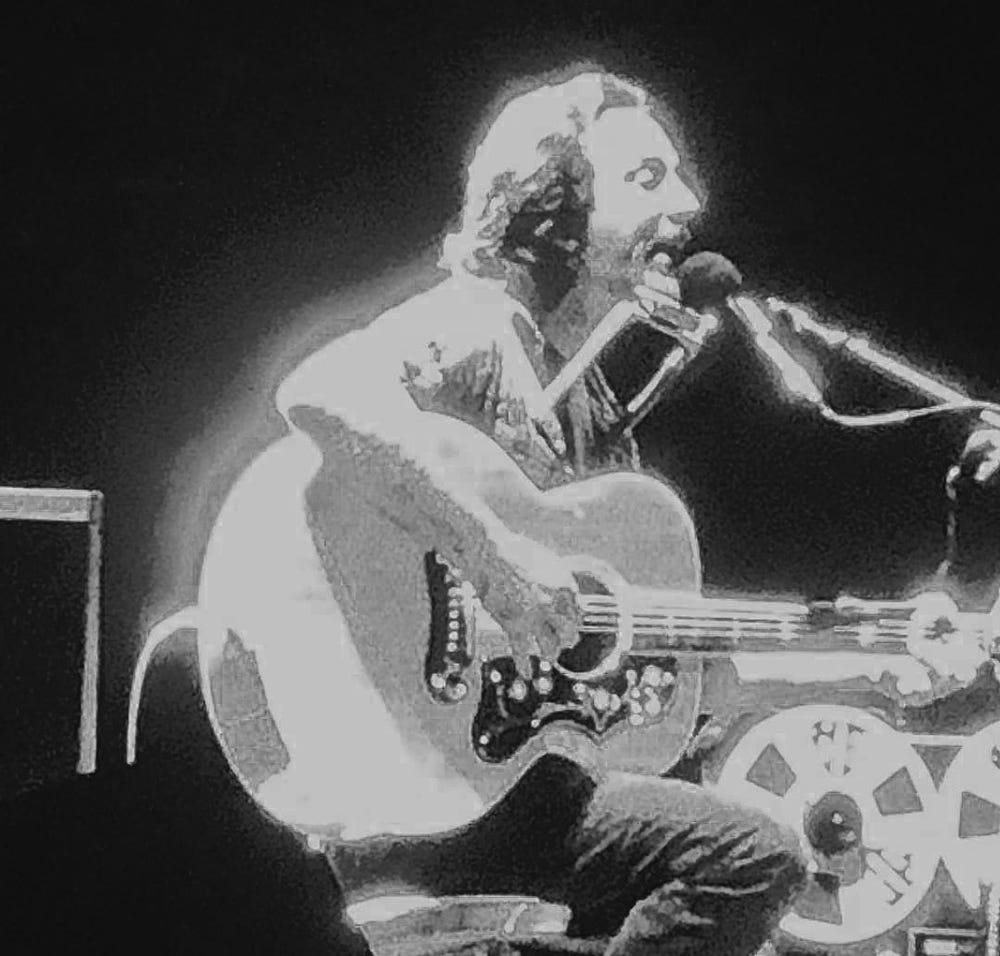
Suffering reverberated off those fraying strings. There were deep scratches on that sitka and mahogany guitar. Yet, that pain wasn’t the only sound reshaping rock.
If Nirvana wrote what most call the genre-destroying song, Pearl Jam wrote the perfect album. Not “perfect for its time” or “perfect within the grunge canon.” Perfect. Period. I know, there’s an urge, when talking about Ten, to apologize before making a case for it. The folks at Pitchfork wrote off my argument; they gave the Redux a 6.7. But that proves my point. They don’t really hear Eddie. Critics apologize because the collection of anthems sold a zillion copies. Because it’s earnest. They want to posture; prove their smarts and tell the public they don’t quite understand music.
I get it. That earnestness doesn’t fit perfectly in an era that prefers irony, distance, and pain. Want to experience sorrow? Try Cornell’s live performances.; it’s hard for me to listen to these all the way through anymore when then end is written.
And yet.
Strip away the baggage, the dad rock old flannel reflex, and what I’m left with is something few albums achieve and fewer even attempt.
Pearl Jam just doesn’t blink.
That’s not my nostalgia talking. It’s a deliberate structure, every song has its place during the Musicland store days when one catchy tune sold gobs of records. The original recording highlights a band that roars inside an arena. Eddie Vedder fronts, arguably, the best live band of all-time. Their debut lets the instruments take center stage. It’s drenched in reverb, yes. That arena reverb creates distance; Eddie sounds like he’s shouting from the stage to the cheap-seat rafters. The guitars wash over in waves. Epic, sure, but this effect hides something. When everything is drenched in echo, this creates space between the listener and performance. You’re hearing the arena as much as the band.
I love it.
So what did Brendan O’Brien do, exactly? What makes this remix of sorts special? And why do I find it fascinating? Hard to say definitely (they didn’t call me to be a fly on the wall), but he understood that Ten didn’t need more production—it needed less.
The band let their long-time producer take the original cuts and tweak them ever so slightly. Subtle. You see, O’Brien worked with Pearl Jam later, joining forces on Vs, Vitalogy, and Yield. I’d like to think this version is a true what could have been moment; what if I’d been the one to work with them first? This isn’t a technical restoration. And for the band to allow this; well, this doesn’t happen everyday. I wonder if O’Brien won a card game, going all-in with a full house to pull off the privilege.
The Redux is a reimagining because the producer realized there isn’t another voice like this one. I know, it’s Eddie effing Vedder. But if you want to understand emerging greatness, use Spotify, Apple, or other service of choice (better yet, dig up a CD from a pawn shop music) and find Temple of the Dog, a one-shot triumph to raise money for another fallen grunge god. There’s a single song where Chris Cornell and Eddie Vedder roar together. Yes, Chris is the Grunge God. Four octave voice. Few have this range.
But Eddie is the baritone All-Father. Yes, Chris fronted two legendary rock bands in Audioslave and Soundgarden. He opens Hunger Strike, his voice raw, and then Vedder cuts in shortly after the minute mark. Play the song, hear that roar, this is an up-and-comer introducing himself to the rock universe.
Damn, it’s that good.
Brendan O’Brien understood what made Pearl Jam more than a band. It was a cohesive unit fronted by a voice that’s going somewhere. This insight is what separates understanding from genius-level inspiration, knowing when a voice needs protection and when to let it ride. And in Ten’s Redux version, he cuts the reverb, pushing the vocals forward. I didn’t notice differences on every track. But play Black, turn up the volume, and Vedder is inside your living room. Here the difference isn’t subtle, it’s transformative. On the original, Vedder’s voice flattens in that arena space, that distance again. O’Brien strips all that away. Now you hear the grain in his voice, the breath between phrasing, the exact moment where the signature growl emerges. He’s not performing for thousands; he’s confessing to you alone. There was protection in the original. O’Brien removes it. This is rock god glorious and shows why this album, down to its scaffolding, is special.
And that’s the hidden, often overlooked, secret this album carried from the beginning; it’s incredible even if you strip some of it away.
Ten never needed arena reverb because the songs were built for stadiums; they were already larger than life. The structure, the sequencing, the refusal to compromise—it was always there.
What Ten Gets Right That Most Albums Don’t
I’d love to know how the band approached their initial release. What is the writing and working process to build a piece so original, so cutting. I’d argue their later work never touched that same high. Yes, Vs is great. Vitalogy peaks with Better Man. Lightning Bolt gifted Sirens. Backspacer might have the best short sequence for running play lists between Get Some and Unthought Known. And Yield is the closest to the original high. But, for me, I can hit play on Ten, no matter what version, and listen straight through. Few albums carry this kind of courage—the absolute refusal to compromise on a vision. There are a handful of others that share this DNA:
Abbey Road, the Beatles knew this was the end, so they held nothing back.
Automatic for the People, R.E.M became quiet, trusting their work.
The Joshua Tree, U2 at their finest.
Pet Sounds, Brian Wilson risked everything on studio experimentation, including his own sanity.
Johnny Cash at Folsom Prison, one has to be honest playing in front of inmates with just a guitar.
Maybe, you only get one album before you know who you are, realize who’s watching, and what expectation can do in limiting the creative process.
Isn’t It Obvious? Or there is a simpler answer.
Big choruses. That voice. Soaring guitars. There is no puzzle to solve. Ten isn’t cute like a Pomeranian puppy strapped to an italian leather leash. Nobody roars like a ship crashing through the dock and onto the beach. Sure, the critics cite smarter albums. Or call attention to others with superior arrangements. But few are as willing to say exactly what they mean, at full volume, for nearly an hour, without apologizing.
I’m glad Apple glitched.
I’ve listened to both versions multiple times, picking up those minute differences. I’ve discovered Ten belongs in the canon of artistic statements—an album so structurally sound that even a remix 18 years later can’t break it. Some may argue, but, in places, the tuning only made it better.
And that, more than flannel or any grunge god mythology or ethos, is why this album lasts. Do yourself a favor, listen to both versions. You’ll thank me later.
Footnotes
This is the Martin guitar, fetching the highest sum ever at auction, played by Cobain during the famous MTV Unplugged performance.
Well, I looked it up, and the folks at Pitchfork gave Pearl Jam’s Redux a 6.7. Screw those guys. If you’re curious, there are a handful of albums to receive Pitchfork Perfection. Few, if any, do I listen to on a semi-regular basis, and they haven’t handed out the honor in over five years. Picky indeed.
Musicland was a prominent specialty retailer of music and movies, founded in the mid-1950s and dominant in mall-based retail by the 1990s. These were everywhere, operating over 1,300 stores under brands like Sam Goody and Suncoast Motion Picture Company until it was acquired by Best Buy in 2001.
Garden soars on the Redux, trust me. Again, the original buries the vocal, letting the instrumental dominate. O’Brien flips this, bringing Vedder forward, and you hear a certain desperation to the voice. The reverb sounds like a stadium anthem. Without it, this is a prayer for those lost to violence. Once forgotten memories don’t prop Alive up. And no, I can’t stop listening to that opening, those shades of empty canyons.
Headlining taken at the Pilgrimage Musical Festival in 2017.
Be Cool, Pass The JPLA On …
Accidental Romantasy (What I’m Reading)
The Invisible Life of Addie LaRue by V.E. Schwab was an amazing feat, published in 2020. I love books with Faustian bargains. Here, a woman wants to live forever, makes a bargain with a devil-like figure, but realizes later that she can never be remembered. It’s a beautiful book; Schwab is a far better writer than myself. Her craft has a certain elegance versus my brute force and rapid fire staccato rhythm.
So when I heard about her latest, Bury Our Bones in the Midnight Soil, I jumped. I didn’t check the merchandise on her site beforehand advertising toxic lesbian vampires; however, I loved Anne Rice books, even Stephanie Meyer’s opus series that began the bloodsucker love-story genre works for me. Yet, this didn’t quite land. I do understand why an author would want to dip their toe in these waters. Matthew Haig’s latest sold a million copies, but a mediocre Romantasy novel will push ten times that many books. The genre is having a moment. But that doesn’t mean you should compromise on your initial vision. I’m not saying that happened… the execution felt a little off, like the commitment wasn’t quite there. Who knows, maybe I should get on board, try my hand at the genre. I mean, why not?
A Grunge Revival (An Apple Music Revival)
I’ve recommended enough albums already in this edition, but I had never listened to Chris Cornell’s Higher Truth—released in 2017. Acoustic. Even a harmonica makes an appearance. And that voice with a four octave range, carrying unusual power for a tenor without thinning. That controlled rasp moves between brute-force intensity and a vulnerable echo, so much so I might have to update my list of his best. There are a couple of treasures here.
Academy Awards (What I Watched)
I judge the success of the academy on if I’ve watched a single movie. There have been years in the past where I’ve seen like one. This year, I did better: One Battle After Another, Sinners, F1, and Hamnet. Of these four, I gave up on one of them. But Hamnet, like I’ve said before, oh it’s so good. I’ll probably get a couple more in this weekend; the weather outside, oh it’s frightful.
A Claude Code Affair (What I’m Tinkering With)
Claude is getting its legs with Opus 4.5, it’s truly revolutionary what it can do. And has the uncanny ability to push through when it makes mistakes, often forging ahead with reckless abandon.
That being said, OpenAI also has a similar tool called Codex. And it’s gpt-5.2-codex model running in xhigh mode, although slow, makes few errors, if any.
Thank you for reading! The JPLA is a reader-supported publication. If you can, please share these musings with your friends. Although not required, consider becoming a paid subscriber in the future; I appreciate all tokens of appreciation.
The Vision Finds You Edition
“Those lyrics weren’t about trying to say something clever. They were about getting something out.”
