
Charta, A Writer's Desk
Alfred Bigelow. iOmega. WordPress. Design Principles. Embeddings. Huntrix. Babel. Cloudflare. And Juice Kiffin.

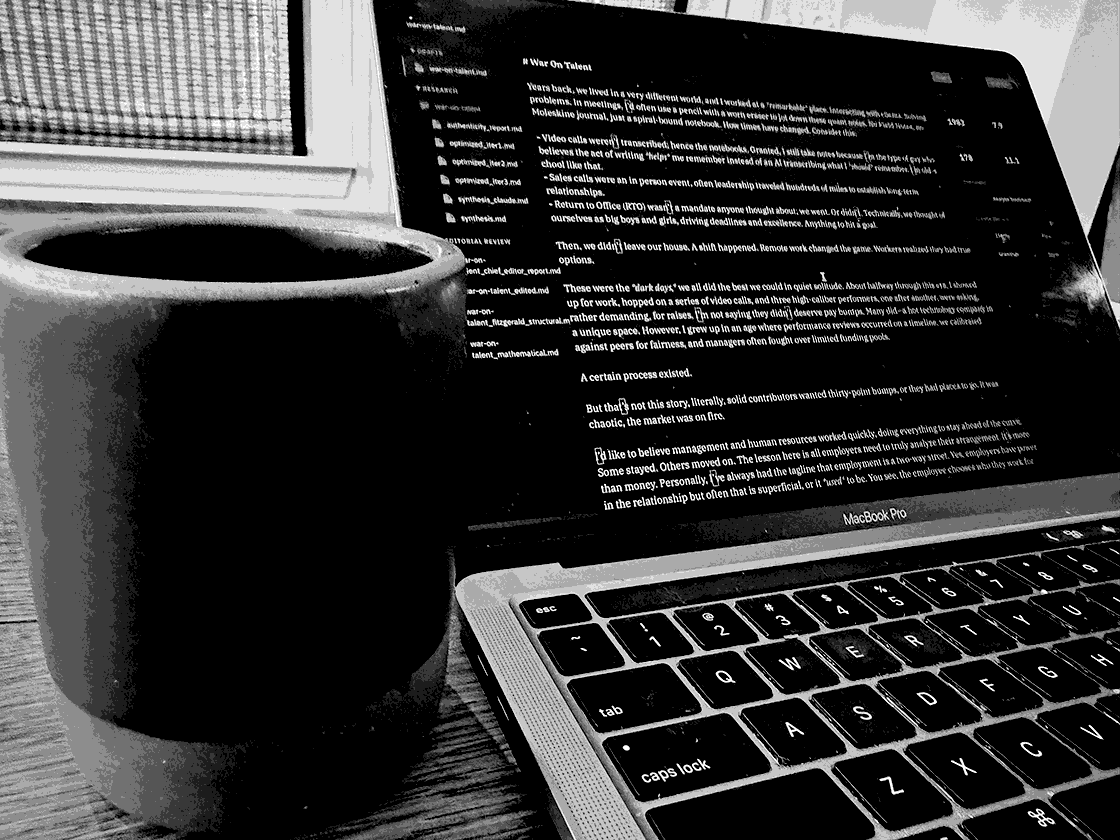
Each Thanksgiving, I jot down my gratitude list. It’s often long and winding—texting with friends on College GameDay always makes the cut, debating Mizzou’s Drinkwitz always predictable play calling.
As for the article ahead, the President delivered a shot of inspiration during a short interview on an overseas trip, leading me to retool my entire web stack. The prose is wonky, heavily laden with text analysis, so feel free to skip if this isn’t for you. But what the rather lengthy project made me realize is that my writing follows little convention, often is random in nature, so I do appreciate those who have stuck with it over the years. As always, onward. And, or course, many thanks and all the best over the holiday season.
Building Charta, A Writer’s Desk
Donald Trump. These two words are triggering. Stir great joy in some. Piss and bile for others. And there is the mix in-between for those who don’t care and have grown tired. Traveling in South Korea, he made this broad statement about the United States beginning nuclear testing in an off-hand comment and this cascaded throughout news sites globally. Just another day in US politics, I know. The horror? Are you not entertained? I don’t even think the world knew what he meant. And he probably didn’t either.
Yet, I noticed a few articles about Alfred Bigelow popping up afterward. Here, I quote the great Obi-Wan, “That’s a name I haven’t heard...”
The Voyage of the Golden Rule
He’s seldom-referenced in textbooks these days. If you’ve never heard of him, Bigelow was a Navy commander who had seen the best and worst of war, turning his back on the uniform after World War II—not out of any bitterness, more moral clarity on his part. What he saw in the postwar rush toward nuclear dominance wasn’t strength; it was madness dressed up in a Linus-like security blanket. In 1958, he set sail on the Golden Rule, a modest wooden boat aimed straight into the Pacific test zone’s heart. He and his crew never made it to the blast site; the Coast Guard stopped them long before coming into harm’s way.
But he made a point, one sailboat against the nuclear age and rewrote the definition of protest.
He didn’t shout. Or get angry. He simply sailed.
An English Essay
You may not care about any of this but hearing the name brought me back to dust-filled libraries, where you researched historical figures on microfilm in a seldom-used room. You should try explaining this process to your kids; it’ll be mind-blowing. Trust me.
Weeks later, I wrote this incredible piece titled, Alfred Bigelow and the Voyage of the Golden Rule. I modeled my title after a Sinbad movie, the ones with the claymation special effects. Giant spiders. Impossible creatures. This was for an English assignment about protest, peaceful and otherwise. Sure, I could have chosen any topic; yet, I picked this obscure figure, at least compared to other options including MLK, Gandhi, and Thoreau. The former Navy officer isn’t exactly sitting atop the famous person mountain.
In the splinter of my own mind, the story I tell myself, this turned into a work of dramatic proportions. The greatest college essay ever devised. Truly, Pulitzer-worthy work.
I lost it on a corrupted floppy disk. Or on one of those iOmega Drives—those were cool too. Sigh, it’s gone.
I tried explaining floppy disks to my kid too, but he didn’t follow the concept of college computer labs either. Know what I’m talking about? Go to the building, take a number, wait for a spot to free up, and write for an hour. Because they limit time, this became my Pomodoro Technique to crank out a draft. About every third week, a cute virus showed up on my 3.5” disk, threatening my work. I’d cross my fingers, sometimes the computer gods shone down upon me, and I fixed the problem. Other times I wasn’t so lucky.
These were glory days. I know, it’s like my microfilm story, the tech version of walking three miles in the snow barefoot to catch the bus. My kid has heard that one too.
But during this era, I lost more than enough work, which is why I ultimately chose WordPress for my writing spot in the mid-2000s. It was sold as a forever place for writers. And I give the platform credit, I wrote my first post nearly fifteen years ago, and it’s never left me, far outlasting any failing hard drive.
That being said, there have been issues in my own workflow. If I publish on WordPress, where is the canonical version? The text file on my laptop? The one hiding out somewhere on a cloud-service? The news media struggles with this problem too, leading to the right and left claiming history is being re-written. It’s so tempting to change an opinion piece if one feels the historical record calls a belief in question. I’d hate to see the change control history on WhiteHouse.gov over the previous eight years; it’s a seesaw. Luckily, my issues are more about swapping out a comma online and forgetting to make the change on my laptop to keep everything in sync.
Given this nagging issue along with the recent infighting and court battles bubbling in the WordPress community, I started to wonder what would happen if pieces of my work were lost. My European travel tips aren’t important to everyone, I know. Or those Kung-Fu Panda Quotes. However, they are important to me.
So I decided to resolve, not the world’s problems, but my own oft self-inflicted mess. Time to build!
Design Principles, North Stars
These, theoretically, should exist in any project, those unbreakable principles. In life, we call these values: truth, justice, the American way. I sketched out a few for this effort:
Byte-Level. Thanos has this great line in the Avengers, technically he has dozens (that’s why he’s an amazing character), “I’m thankful. Because now, I know what I must do. I will shred this universe down to its last atom...” Translation, I wanted all articles or posts to live in readable plain text so I can analyze down to the punctuation. Markdown for the content itself. YAML for metadata headers. No binary formats anywhere. No proprietary schemas to decode. Everything is git trackable. If my hosting provider disappears tomorrow, I wanted to deploy elsewhere (AWS, Cloudflare, my own closet server) in literally minutes.
One Source of Truth. Today, I use multiple tools. As each of these articles is written in markdown, I can tinker in iAWriter. Edit in Word. Play in Scrivener. Write where I want, save. And then, I can export to the web, or any other format for that matter. Everything remains in sync because I use a single file that pushes instead of multiple taking on a life of their own.
A Separation of Concerns. Extract references from one script. Generate markdown from another. Build HTML with a third. Each phase of a documented writing pipeline had to stand alone. If tags change somewhere, rebuild the tags. If content changes, rebuild only that content. The system doesn’t guess, it does what you tell it. And I can run any step twice and receive the same result both times. No side effects. No hidden states between runs. The build is deterministic. The same markdown files always produce identical HTML output every single time. Think Unix philosophy and modern build systems. Each script does exactly one job and does it well.
Vanishing Act. No analytics tracking. No pixels embedded. No tracking scripts running anywhere. We’ve all seen platforms optimize for pure engagement. Notifications popping up. Badges lighting up. Recommendations pushing everyone somewhere, sometimes to Shady Sam’s back alley adventure designed to keep you scrolling mindlessly forever. I wanted the exact opposite. Show up when you want. Read what interests you. Leave when you’re done. No guilt. No hooks. No using my content to recommend something else. No, well, bullshit.
A Narrative Generation Engine, Charta
All writing platforms end up sharing similar goals: your content and attention, wrapped into a legally binding fine print. Medium, Substack, WordPress hosting platforms—they all begin with good intentions. Write freely. Build an audience. Keep it simple. Then their business model kicks in eventually, it’s just economics. Paywalls appear. Features get gated. Terms change. The platform that promised to amplify your voice starts tuning the algorithm for its own growth instead. Competition creates chaos too, pushing teams in directions that might not have made sense or conflict with the vision.
So I built something different, if imperfect, leveraging AI and my own hack skills. Trust me, mistakes were made.
I call it Charta. I always wanted to use a cool codename for a project. Apple uses second homes, think Tahoe or Sonoma. Years ago, I wrote a flawed character by the name of Elliot Downs. The Day Life Breaks is not a perfect book, but he had a moment—two chapters of glory where he passionately delivered his company’s ethos. My charta is nothing as bold as his manifesto; yet, I thought a subtle nod might be worthwhile. Ideas stick with you; it’s best to act on them, I guess.
This Charta, at its core, transforms Markdown files into a static website. No database required. No admin panel. No JavaScript bloat weighing things down. Well, there is a little javascript. But I wanted fast pages that load in milliseconds and cost almost nothing to host anywhere. And that’s what this does, imperfectly. No, this isn’t a content management system. It’s more of a NGE (Narrative Generative Engine) that finds trends in prose. Here is what I delivered in Build 0.1:
Tag Analytics. Every article is tagged. Those tags roll up into gravity scores based on frequency, recency, and distribution patterns. Want to know what you actually write about over time? The system showed me. Not what I thought I wrote. What the data says I wrote. There’s a difference between the two. It’s been humbling.
Semantic Relationships. Embeddings map every article into a high-dimensional vector space. Related content surfaces based on actual meaning, not just matching keywords. If you write about typewriters and nostalgia in different pieces, the algorithm connects them automatically even when they don’t share identical vocabulary. I write about typewriters too much, I think.
Fingerprints. This beast analyzes sentence length, lexical density, question frequency, hedge words, certainty markers, and vocabulary patterns. It built a statistical model of my voice dating back to 2012. Then I decided to check my own drafts against that baseline model. Does my style drift? Am I writing too formally against my usual tone? Did I lose the thread somehow? Should I evolve more?
Bibliography Management. Every reference gets extracted and indexed automatically. Footnotes roll into a living bibliography, what sources I lean on repeatedly, which threads connect across years of writing. It’s not vanity. It’s memory. I’m old. I forget.
Stylistic Tooling. Sentence-level analytics track everything from tense posture to emotional arcs. Punctuation density too. Yes, I can tell you exactly how many commas appear on this site, down to that last atom again. No, you probably don’t want to know the actual number because I have an awful problem with run on forever sentences.
Yes, Charta notices when I’m coasting. Sadly, I have more than a few of those articles.
The Future, What’s Next
For now, I’m testing if the new workflow works (this is a first-level cut, a simple test). Maybe, one day, I’ll open-source parts. Perhaps I’ll write better documentation. Or build a writer’s workbench that’s more GUI based. But honestly, I built this for me. When I was about half-way through, I found a number of general-purpose site generators out there that are absolutely fantastic including Hugo and Astro. Give them a spin as they perform better than what I came up with. But this solves specific problems and scratches an itch, fitting my workflow to write, track, analyze, and publish.
And I plan to keep tinkering, using the little analytical engine that could, at least for a while longer. Onward.
The Footnotes
I wonder if content websites as we know them might be obsolete within the next two years. If everyone uses Google Gemini, or ChatGPT, or Claude as an interface, do these writing spots even matter? Or will they evolve into json dumps for the AI gods to read? Something to ponder.
Astro is next-level great; it’s beginning to eat WordPress market share. This is a feeling, no data provided.
Be Cool, Pass The JPLA On …
kPop Demon Hunting (What I’m Watching):
I finally succumbed to Team Huntrix; I’m late to the game here. Maybe the SNL skit pushed me to take the leap. Props to Sony for creating this animated juggernaut and Netflix for stealing the upside with the distribution rights. With the winnings, Reed Hastings and team announced a buyout of Time Warner.
Crazy times?
Or is it the end times? I just don’t know about this move for shareholders but maybe take the upside and sell a little if this is approved—somebody tries this play each decade and it never ends well… RIP AOL.
Babel, A Towering Achievement (What I’m Reading):
Noticed R.F. Kuang launched her new book, Katabasis, in August. I picked it up, then realized I never read Babel so shifted gears. This is a fantasy set in an alternate 1830s Oxford where translation is indeed magic: words from various languages, etched into silver bars, power the British Empire. I’m a hundred pages in and absolutely love how word origins become a critical part of the plot. Reminds me of the introduction in Emily Wilson’s Odyssey translation, except in this world it’s part of the lore’s magic system.
Cloudflare Cut-Over (What I Was Tinkering With Edition):
Using Charta, I cut-over my blog two weeks ago, moving from my previous hosting provider to Cloudflare. My site doesn’t possess FoxNews traffic volume, but I’ve been writing online since 2012 and have a few posts that drives eyeballs. So far, so good. Page speed has tripled. And true to form, I don’t have services for search, etc., that track users or slow down the site. We’ll see if the maintenance is worth the effort, I’ve seen more than a few Content Management Systems (CMS) die a slow death.
But during the migration process, I noticed older posts had these long, random footnotes. I’d be writing on the election or hiking in the mountains. Then, I’d make a footnote to rant about ESPN ripping on the Cardinals, completely off topic. I quit doing this because the theme or platform didn’t support the function easily. Ended up building a little JavaScript to bring back the concept. Still have tinkering to do on image management, etc., but it’s been fun channeling my inner Dreamweaver again.
A Chuck Norris Apology
A few readers reminded me that Chuck Norris can start a fire by rubbing two ice cubes together. So I apologize if I in any way hinted that a ninja could take down Lone Wolf McQuade. It’s not possible. Also, I’ll be changing my address next week just in case he shows up on my doorstep; your Christmas cards will return by carrier pigeon.
Thank you for reading! The JPLA is a reader-supported publication. If you can, please share these musings with your friends. Although not required, consider becoming a paid subscriber in the future; I appreciate all tokens of appreciation.
I’m Being Held Hostage Edition:
“Can’t wait to get down to Baton Rouge with my dad, brother, and sister!”
